AI search is moving fast. Faster than most people realise.
If you’ve ever searched something in Google and seen an AI-generated answer at the top, you’ll know exactly what I mean. No clicking. No scrolling. Just an answer.
And here’s the scary part. A lot of content never makes it into those AI answers because of simple GEO mistakes that are easy to fix once you know what to look for.
Some sites are quietly benefiting from AI visibility. Others are invisible, even though their content is technically “good”.
Let’s fix that.
What Is GEO and Why It Matters for AI Answers
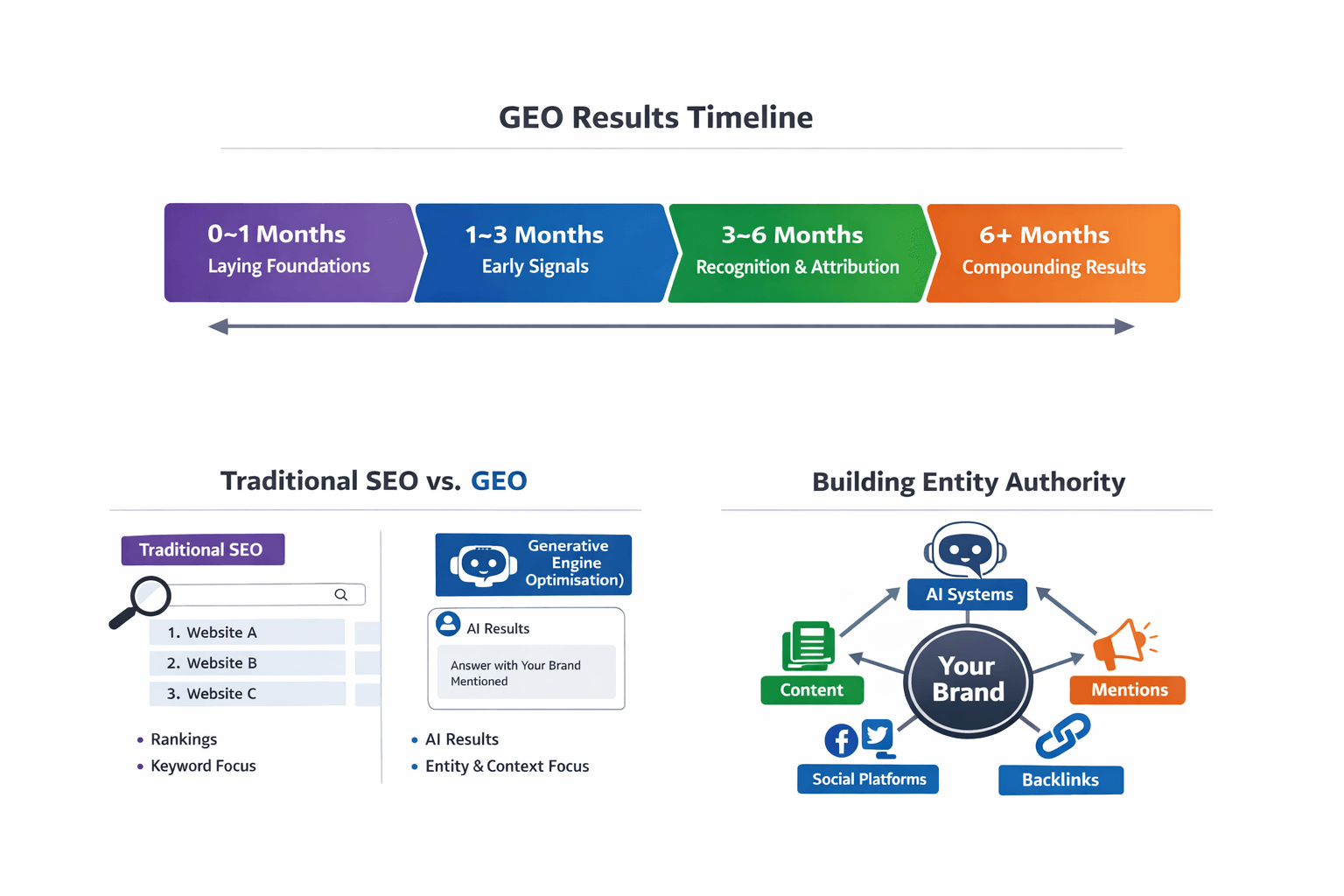
GEO stands for Generative Engine Optimisation. It’s the practice of optimising content so AI systems can understand, trust, and reuse it when generating answers.
Traditional SEO focuses on rankings and clicks. GEO focuses on clarity, structure, and usefulness.
AI tools don’t think like humans. They scan for context, patterns, definitions, and authority signals. If your content is vague or messy, it won’t get picked up, no matter how well it ranks.
That’s why avoiding basic GEO mistakes is now just as important as keyword research.
Mistake One: Writing for Algorithms Instead of Answers
This is the biggest GEO mistake I see.
People are still stuffing keywords into content without actually answering anything properly. AI models don’t care how many times you repeat a phrase. They care about whether your content clearly explains a concept.
If your page dances around the topic and just mentions a bunch of keywords, instead of defining the topic early and clearly, AI systems struggle to use your content.
When I write content now, I imagine someone asking a direct question out loud. Then I answer it within the first few paragraphs.
That alone has made a noticeable difference in how content performs in AI-driven search.
Mistake Two: Burying the Main Point Too Deep
AI doesn’t scroll endlessly like a human reader.
If your definition, explanation, or key insight is hidden halfway down the page, it may never be used. This is a classic GEO issue caused by overly long introductions and paragraphs that don’t get to the point.
Your content should state the core idea quickly. Expand later. Explain first.
Mistake Three: Overloading Content With Jargon
AI prefers simple language.
That doesn’t mean “dumbed down”, but it does mean clear. If your content is packed with acronyms, buzzwords, and vague industry phrases, it becomes harder for AI to interpret accurately.
This is especially important if your audience is new to your topic.
One thing I believe is that content written for beginners actually performs better in AI answers. It’s clearer, more structured, and easier to summarise.
Interesting fact: AI can lie, so triple check everything you read or use!

Mistake Four: Ignoring Entity and Context Signals
AI systems look for context. They want to know what your content is about, who it’s for, and how it fits into the wider topic.
If your page only focuses on one keyword without surrounding context, it limits its usefulness.
This means naturally including related terms, examples, and explanations that reinforce the topic. Not as a checklist, but as part of the story you’re telling.
When content feels complete, AI is more confident pulling from it.
Mistake Five: Writing Long Paragraphs That Are Hard to Extract
Big walls of text are bad for humans and bad for AI.
AI systems often extract short passages to build answers. If your paragraphs are long and rambling, it becomes harder to isolate useful information.
This is why I keep paragraphs short and focused. One idea per paragraph. Two or three sentences at most.
It’s not just about readability anymore. It’s about extractability.
Mistake Six: No Clear Opinion or Experience
This might surprise you.
AI systems are increasingly trained to value experience-based content. Pages that sound generic or templated are less useful than those that include judgement, insight, or first-hand experience.
You don’t need to be controversial. You just need to sound human. This also holds true for SEO with E-E-A-T.
Even a single opinion, used carefully, can separate your content from thousands of near-identical posts.
How to Fix GEO Mistakes Going Forward
Start by reviewing your existing content. Ask yourself whether each page actually answers a question clearly.
Then look at the structure. Are your key explanations easy to find? Are your paragraphs skimmable? Does the content feel confident and complete?
GEO is about making your content easier to understand and reuse. If you get that right, the visibility tends to follow.
Final Thoughts
AI answers aren’t replacing SEO. They’re evolving it.
The sites that win are the ones that adapt early and avoid simple GEO mistakes that hold everything back. If you focus on clarity, structure, and real experience, you’re already ahead of most people.
If you want help reviewing or updating your content for GEO, that’s exactly the sort of thing I do every day. You just need to start thinking beyond rankings.