SEO is changing again. And this time, it’s not another algorithm update you can ignore.
Over the past year, I’ve seen clients lose clicks even when their rankings stayed the same. Same positions, same keywords, but less traffic. Why? Generative search engines.
If you’ve noticed Google answering questions directly, or ChatGPT summarising content without sending users to a website, you’re already seeing generative engine optimisation in action. In this guide, I’ll break down what generative engine optimisation (GEO) really means, why it matters, and how you should start thinking about SEO in a world where AI generates answers instead of just links.
What Is Generative Engine Optimisation?
Generative engine optimisation, often shortened to GEO, is the process of optimising your content so it can be understood, selected, and referenced by AI-powered search engines.
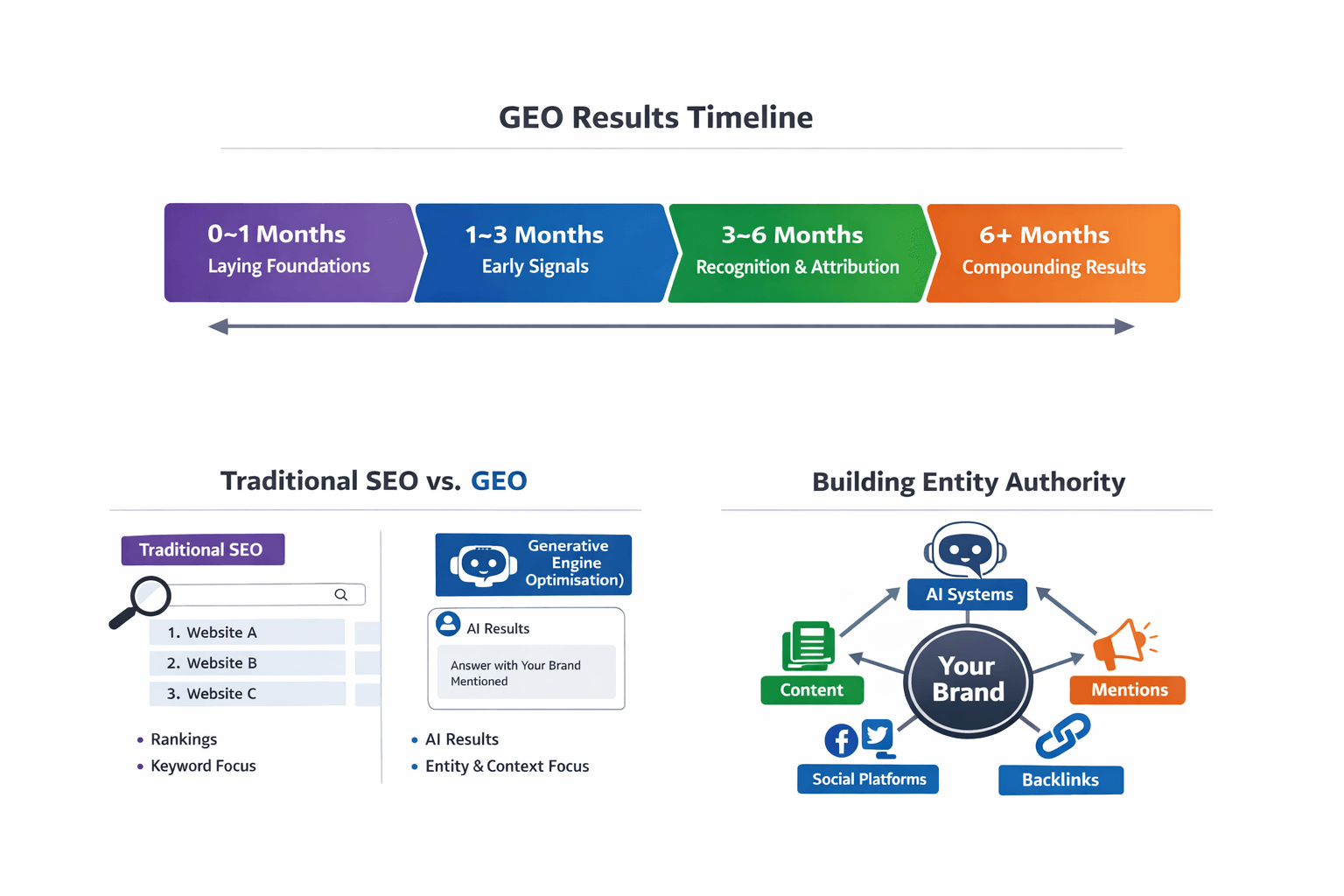
Unlike traditional SEO, where the goal is to rank a blue link on page one, generative engine optimisation focuses on visibility within AI-generated answers. This includes platforms like Google’s Search Generative Experience, Perplexity, ChatGPT, and other large language models.
Instead of ranking pages, these engines generate responses using information pulled from multiple sources. Your content doesn’t need to rank first to be used, but it does need to be clear, authoritative, and contextually useful.
How Generative Search Engines Actually Work
Traditional search engines crawl pages, index keywords, and rank results based on relevance and authority. Generative engines work differently.
They analyse language patterns, entities, context, and meaning using natural language processing. Content is broken down into chunks, concepts, and relationships rather than just keywords and links.
When a user asks a question, the AI doesn’t “search” in the normal sense. It predicts the most accurate answer based on its training data and live sources, often pulling supporting information from trusted websites.
This is why generative engine optimisation relies heavily on semantic relevance, topical authority, and clear explanations.
Generative Engine Optimisation vs Traditional SEO
GEO vs SEO is where most people get confused.
Generative engine optimisation does not replace SEO. It sits on top of it.
Traditional SEO focuses on rankings, clicks, and traffic. GEO focuses on inclusion, citation, and influence within AI responses. A page might never rank top three but still be used as a trusted source by a generative engine.
From what I’ve seen in real campaigns, pages that perform well in generative search are usually well-structured, written clearly, and focused on answering specific questions properly.
Why Generative Engine Optimisation Matters Now
Ignoring generative engine optimisation is risky. Search behaviour is changing fast.
Users are getting answers without clicking. That means fewer opportunities to capture attention unless your brand or website is referenced directly in the generated response.
For businesses, this affects brand visibility, trust, and future traffic. If AI engines consistently reference your content, you become part of the answer, not just another result.
I’ve already had clients ask why competitors are being “quoted” by AI tools when they aren’t. That’s generative engine optimisation at its best.

What Types of Content Perform Well in Generative Engines?
Generative engines prefer content that is clear, factual, and well-organised.
Guides, definitions, how-to explanations, comparisons, and educational content tend to perform best. In other words, generative engines love blog posts. Pages that clearly explain a topic step by step are easier for AI to interpret and reuse.
In contrast, vague marketing pages, thin affiliate content, and over-optimised blog posts struggle. If content exists purely to rank and not to explain, it rarely gets picked up by AI systems.
This is where beginner-friendly content actually becomes a strength.
The Role of Entities and Context in GEO
Entities are people, places, brands, concepts, and objects that AI systems recognise and understand.
Generative engine optimisation relies heavily on entity relationships. Instead of repeating a keyword, you need to cover the topic in full by explaining how related concepts connect.
For example, when writing about ecommerce SEO, relevant entities include online stores, product pages, category pages, search engines, user experience, conversion rate optimisation, on-page SEO, and many more.
When these entities are used naturally and explained clearly, AI systems gain confidence in your content.
Search Intent Still Matters (More Than Ever)
One thing that hasn’t changed is intent.
Generative engines are obsessed with intent. They want to deliver the best possible answer for the question being asked. If your content doesn’t match that intent, it won’t be used.
Informational intent works best for GEO. People asking “what is”, “how does”, or “why” questions are more likely to trigger AI-generated responses.
This is why pillar posts, beginner guides, and educational resources are perfect candidates for generative engine optimisation.
How Trust and Authority Influence AI Answers
AI engines are cautious. They don’t want to generate misleading or incorrect information for their users.
Content that demonstrates experience, clarity, and accuracy is far more likely to be referenced. This includes showing real-world understanding, practical examples, and consistent explanations.
From my experience, content written from first-hand knowledge performs better than generic definitions copied from elsewhere. AI systems seem to favour content that feels genuinely useful rather than manufactured for rankings.
In other words, write for users first in a conversational manner and you may just get cited by an AI chatbot.
Generative Engine Optimisation and E-E-A-T
E-E-A-T still matters, but it looks slightly different in generative search.
Experience and expertise show up through clarity and depth. Authoritativeness comes from consistent topical coverage. Trustworthiness comes from accuracy and structure.
Simple things like explaining terms properly, avoiding contradictions, and writing confidently all help. You don’t need fancy credentials, but you do need to sound like you know what you’re talking about.
This aligns perfectly with writing for humans first, which is what makes great content anyway.

Common Misunderstandings About Generative Engine Optimisation
One big misunderstanding is thinking GEO is about “optimising for ChatGPT”.
You are not optimising for one tool. You are optimising for how AI systems understand and reuse content. That means focusing on structure, clarity, and meaning rather than hacks or shortcuts.
Another misconception is that GEO requires brand-new content. In reality, many existing blog posts can be optimised for generative engines with better explanations, clearer headings, and improved topical depth.
How GEO Fits Into a Modern SEO Strategy
Generative engine optimisation should be part of a wider SEO strategy, not a separate thing.
Keyword research still matters. Technical SEO still matters. Backlinks and off-page SEO still matters. GEO simply changes how content is evaluated and surfaced.
Think of GEO as future-proofing your content. If your page explains a topic clearly enough for an AI to summarise it accurately, it’s probably a strong piece of SEO content anyway.
How to Optimise Content for Generative Engine Optimisation
Generative engine optimisation starts with how you write, not what tool you use.
AI engines need clarity. They need structure. Most importantly, they need content that actually explains something properly without fluff.
When I optimise content for GEO, I focus on whether a section could be lifted, summarised, and reused without losing meaning. If the answer is yes, you’re on the right track.
A good trick is to write as if your audience are ten year olds. Simple, short, and to the point.
Write Like You’re Answering a Real Question
Generative engines respond best to direct answers.
If a user asks “what is a mortgage in principle”, your content should clearly define it early on. Burying the answer halfway down the page makes it harder for AI systems to interpret.
Use Clear Headings That Match Search Language
Headings are critical for generative engine optimisation.
AI systems use headings to understand topic boundaries. If your headings clearly describe what the section answers, your content becomes much easier to extract and summarise.
Instead of clever or vague headings, be specific. If a section explains how something works, say so. This isn’t about creativity, it’s about comprehension.
Structure Content Into Logical Sections
Generative engines love structure.
Breaking content into logical sections helps AI understand how ideas connect. It also makes your content easier for humans to skim, which is a bonus.
Short paragraphs help too. Large blocks of text are harder to parse and often get ignored by both users and machines.
Focus on Topical Coverage, Not Keyword Variations
This is where many people go wrong.
Generative engine optimisation is not about finding dozens of keyword variations. It’s about covering a topic fully so nothing important is missing.
When I optimise a pillar post, I ask myself what a beginner would need to understand the topic from start to finish. If a concept feels implied but not explained, it usually needs its own section.

The Importance of Definitions in GEO
Definitions matter more than ever.
AI engines rely heavily on clear explanations to generate accurate answers. If your content defines terms properly, it becomes a safer source to reference.
This is why beginner guides perform so well in generative search. They explain things properly rather than assuming prior knowledge.
Internal Linking Helps AI Understand Context
Internal links aren’t just for SEO crawlers anymore.
They help AI systems understand how topics on your site relate to each other. When content is connected logically, it reinforces topical authority.
Schema Markup and Generative Search
Schema is still just as important in generative engine optimisation.
While schema doesn’t guarantee inclusion in AI answers, it helps clarify context. Structured data provides additional signals about what your content represents.
FAQ schema, article schema, and author information can all support GEO when used correctly as they build trust with the system.
Content Freshness and GEO
Freshness matters, but not in the way people think.
Generative engines prefer accurate and up-to-date information, not constant rewrites. Updating explanations, examples, and terminology is often enough.
I’ve refreshed older blog posts with clearer wording and improved heading structures and seen them start appearing in AI-generated summaries again.
What Tools Help With Generative Engine Optimisation?
There’s no dedicated GEO tool yet, and anyone claiming otherwise is guessing.
That said, traditional SEO tools still help. Surfer SEO and Neuron Writer are useful for semantic coverage. Google Search Console helps identify content that already gets impressions.
AI tools like ChatGPT can also be used to test clarity. If an AI struggles to summarise your content accurately, that’s a sign it needs improving.
How to Measure Success With Generative Engine Optimisation
This is the tricky part.
Generative engine optimisation doesn’t always show up as traffic. Sometimes it shows up as brand mentions, citations, or indirect engagement – which is why it can be hard to measure progress.
I track changes in impressions, branded searches, and assisted conversions. If users are discovering a brand through AI answers, those signals usually appear elsewhere.
Here is a helpful video on how to add AI Chatbots into your Google Analytics tracking –
It’s not perfect yet, but it’s improving.
Common GEO Mistakes to Avoid
One mistake is trying to optimise for AI instead of users.
If your content reads awkwardly or feels forced, it won’t perform well anywhere. Generative engines are trained on natural language, not SEO checklists.
Another issue is ignoring traditional SEO foundations. GEO works best when technical SEO, internal linking, and keyword research are already aligned. Like we covered before, GEO sits on top of SEO, it doesn’t replace it.
Should You Rewrite Old Content for GEO?
Not always.
Some pages just need better explanations. Others need clearer headings or improved structure. Full rewrites are only necessary when content is thin or outdated.
I usually start with high-performing pages first. If something already ranks or converts, optimising it for generative engines can extend its lifespan.
Generative Engine Optimisation for Businesses
For businesses, GEO is about visibility and trust.
If AI tools consistently reference your content, your brand becomes part of the conversation. This builds authority even when users don’t click straight away.
Local service businesses, educators, and consultants benefit the most. Informational content positions you as the expert long before a sales conversation happens. So you’d better start writing blog posts to position yourself as an authority!
The Future of Generative Engine Optimisation
Generative search is not a generic trend.
AI-generated answers will become more common, more accurate, and more integrated into search engines. GEO will eventually be part of standard SEO practice.
In my opinion, businesses that focus on clear explanations and genuine expertise now will be far ahead of those chasing SEO shortcuts later.
Final Thoughts
Generative engine optimisation is about clarity, structure, and usefulness. It rewards content that explains topics properly and serves real users.
If you understand SEO basics, GEO is not something to fear. It’s simply the next step in how search engines interpret content.
If you want help optimising your content for generative search, or building pillar content that actually stands the test of time, take a look around Click Shark or get in touch. SEO is changing, but good content still wins.