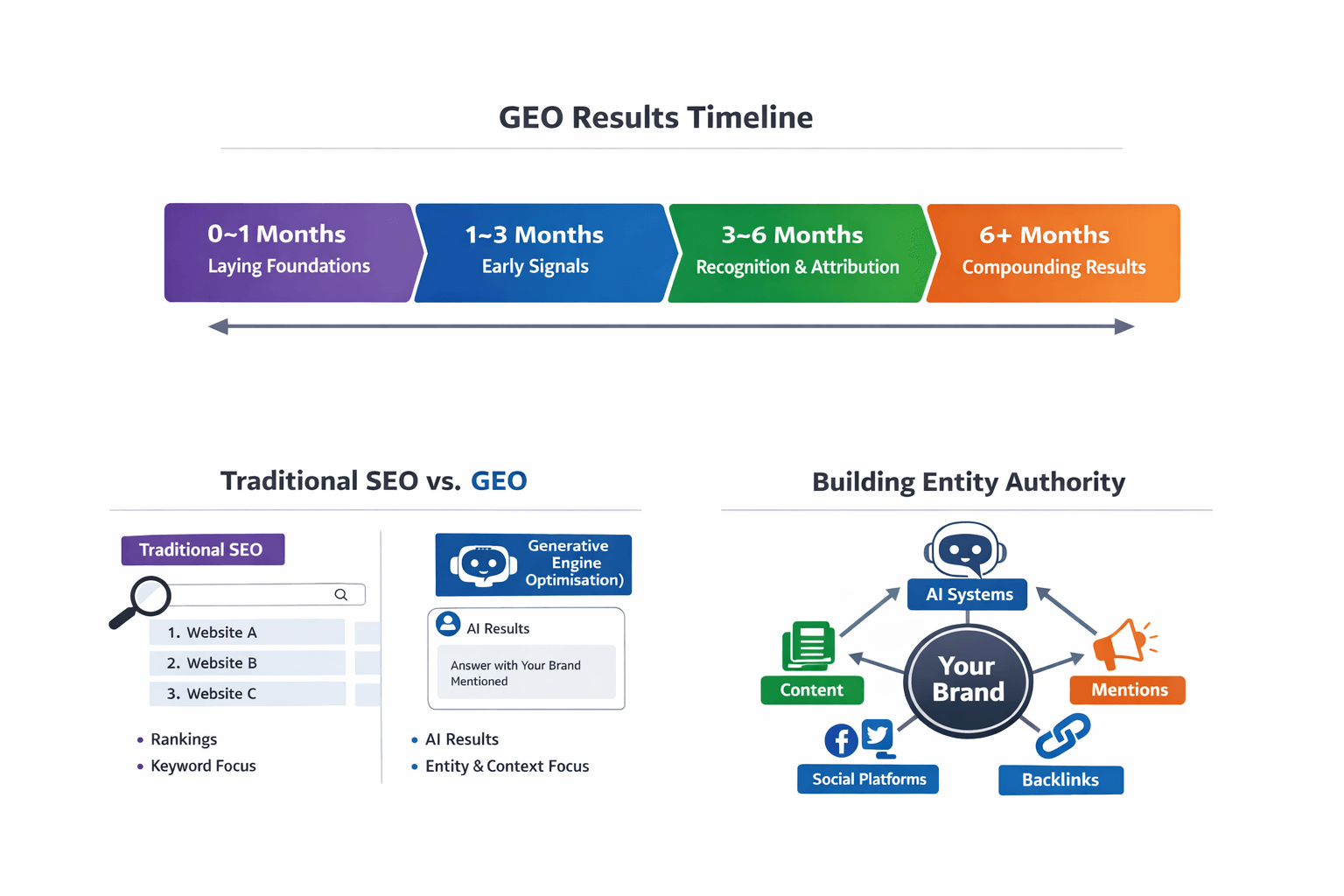
Generative search is changing how people discover information online. Instead of clicking through ten blue links, users are now getting answers pulled from multiple sources and summarised instantly by AI. According to recent studies, more than half of informational searches now trigger some form of AI-generated response.
That shift has forced a big rethink. Ranking for one keyword is no longer enough. If you want visibility, trust, and traffic, you need topical authority for generative search. In this guide, I’ll walk you through exactly how to build it, step by step, based on what I’ve seen work across real SEO campaigns.
What Topical Authority Means in Generative Search
Topical authority is Google and other AI-driven search systems recognising your website as a reliable source on a specific subject. Not just one article. Not just one keyword. The entire topic.
In generative search experiences, AI looks for patterns. It pulls information from websites that consistently cover a subject in depth, use clear entity relationships, and demonstrate expertise over time. If your site only touches a topic once, it is unlikely to be cited or referenced.
Traditional SEO rewarded isolated keyword wins. Generative search rewards coverage, clarity, and consistency. That is the key difference.
Why Topical Authority Matters More Than Ever
Generative AI search models rely heavily on semantic understanding. They analyse entities, context, internal linking, and how thoroughly a topic is explained across multiple pages.
If your content shows shallow coverage, you simply will not be trusted.
In my opinion, topical authority has now overtaken backlinks as the most important long-term SEO asset for informational content. Links still matter, but authority is what gets you cited.
Step 1: Define One Core Topic You Want to Own
Everything starts with focus. You cannot build topical authority across ten different subjects at once, especially on a smaller site.
Choose one core topic that aligns with your business and audience. In the case of this site, the main topic is SEO, therefore topics include On-page SEO, Local SEO, E-commerce SEO etc.
This core topic becomes your topical hub. Every piece of content you publish should clearly connect back to it in some way.
If you skip this step and write randomly, you dilute your authority before you even begin.
Step 2: Break the Topic Into Subtopics and Entities
Once your main topic is defined, you need to map it out properly. This is where most people go wrong.
Think in terms of subtopics, concepts, and entities rather than keywords alone.
Each subtopic should answer a distinct user intent. Informational intent is especially important here because generative search pulls heavily from educational content.
The goal is to make your site feel like a complete resource, not a collection of disconnected blog posts.
For example, imagine my main topic was “mortgages”, my sub topics may include –
- First-time buyer mortgages
- Buy-to-let mortgages
- Commercial mortgages
- Lifetime mortgages
- Remortgages
I could go on here but you get the gist.
Each of your sub-topics should have enough articles to cover the topic entirely. There’s no number here as every topic differs but I usually like to go for 15-25 articles on a certain sub-topic.
Then, when I am finished with that topic (I have published 15+ articles and covered every angle), I move onto the next and rinse and repeat.

Step 3: Create a Pillar Page as Your Foundation
Your pillar page is the central reference point for the topic. It should be comprehensive, clearly structured, and written for beginners.
You should have one pillar page, roughly 2000+ words, per sub-topic.
This page introduces the topic, explains the core concepts, and links out to more detailed supporting articles. It does not need to cover everything in extreme depth, but it must show breadth.
For generative search, clarity matters. Use simple language, short paragraphs, and logical headings so both users and AI systems can understand the content easily.
This page becomes the anchor that all other topical content points back to via smart internal linking.
Step 4: Publish Supporting Content That Goes Deep
This is where authority is built.
Each supporting article should focus on one subtopic and go deeper than your competitors.
Avoid rewriting what already exists. Add practical insights from experience. Share mistakes you have seen, patterns you have noticed, or things that did not work.
Generative search systems are trained to recognise originality and usefulness. Thin content will not help you here.
Step 5: Use Internal Linking to Reinforce Context
Internal linking is no longer just about navigation. It is about teaching AI how your content relates.
Link from your pillar page to all supporting articles, and link back from those articles to the pillar page. Then add contextual links between related subtopics where it makes sense.
Use descriptive anchor text that reflects the topic naturally. Avoid over-optimisation. The goal is clarity, not keyword stuffing.
When done properly, internal linking creates a semantic map of your site that AI systems can follow easily.
Step 6: Optimise for Semantic Keywords, Not Variations
Generative search does not rely on exact match keywords in the same way traditional search did. It looks for meaning.
That means you should naturally include semantic keywords throughout your content.
Do not force them in. If you explain the topic properly, they appear naturally.
Tools like SurferSEO can help identify gaps, but your understanding of the topic matters more than hitting a score.

Step 7: Show Experience and Judgement in Your Content
This is critical for E-E-A-T.
AI-generated answers are more likely to pull from sources that demonstrate real-world experience. That means mentioning areas of your work, challenges you have faced, and decisions you have made.
You do not need to reveal client data. You just need to show that your knowledge comes from doing, not guessing.
This human layer is something most AI-written content lacks, and it is a big opportunity if you use it well.
Step 8: Keep Content Updated and Connected
Topical authority grows over time.
As generative search evolves, new subtopics emerge. When that happens, add new supporting articles and link them into your existing structure.
Update older content to reflect changes in AI search behaviour, terminology, or best practices. Small updates signal freshness and ongoing relevance.
Step 9: Support Authority With Trust Signals
While topical authority is mostly content-driven, trust still matters.
Make sure your site has a clear author presence, an about page, and transparent contact details. Cite credible sources where appropriate, and avoid exaggerated claims.
User engagement also helps. Clear formatting, short paragraphs, and logical flow help users stay longer and understand more, which indirectly reinforces authority.
Generative search systems want to surface content that users trust and understand.
Common Mistakes That Dilute Topical Authority
- One of the biggest mistakes I see is publishing too many shallow posts too quickly. Volume without depth does nothing for generative search.
- Another common issue is poor internal linking. Even strong content can be ignored if it is isolated.
- Finally, chasing trends without a core topic leads to scattered authority. Focus always beats speed.
Final Thoughts on Building Topical Authority for Generative Search
Building topical authority for generative search is not complicated, but it does require discipline. You need focus, structure, and patience.
If you consistently publish content that explains a topic clearly, connects ideas logically, and reflects real experience, AI systems will learn to trust you. When that happens, visibility follows.
Start with one topic. Build it properly. Then expand.
If you want help mapping out topical clusters or building authority-driven content that actually performs in generative search, that is exactly what we do at Click Shark.