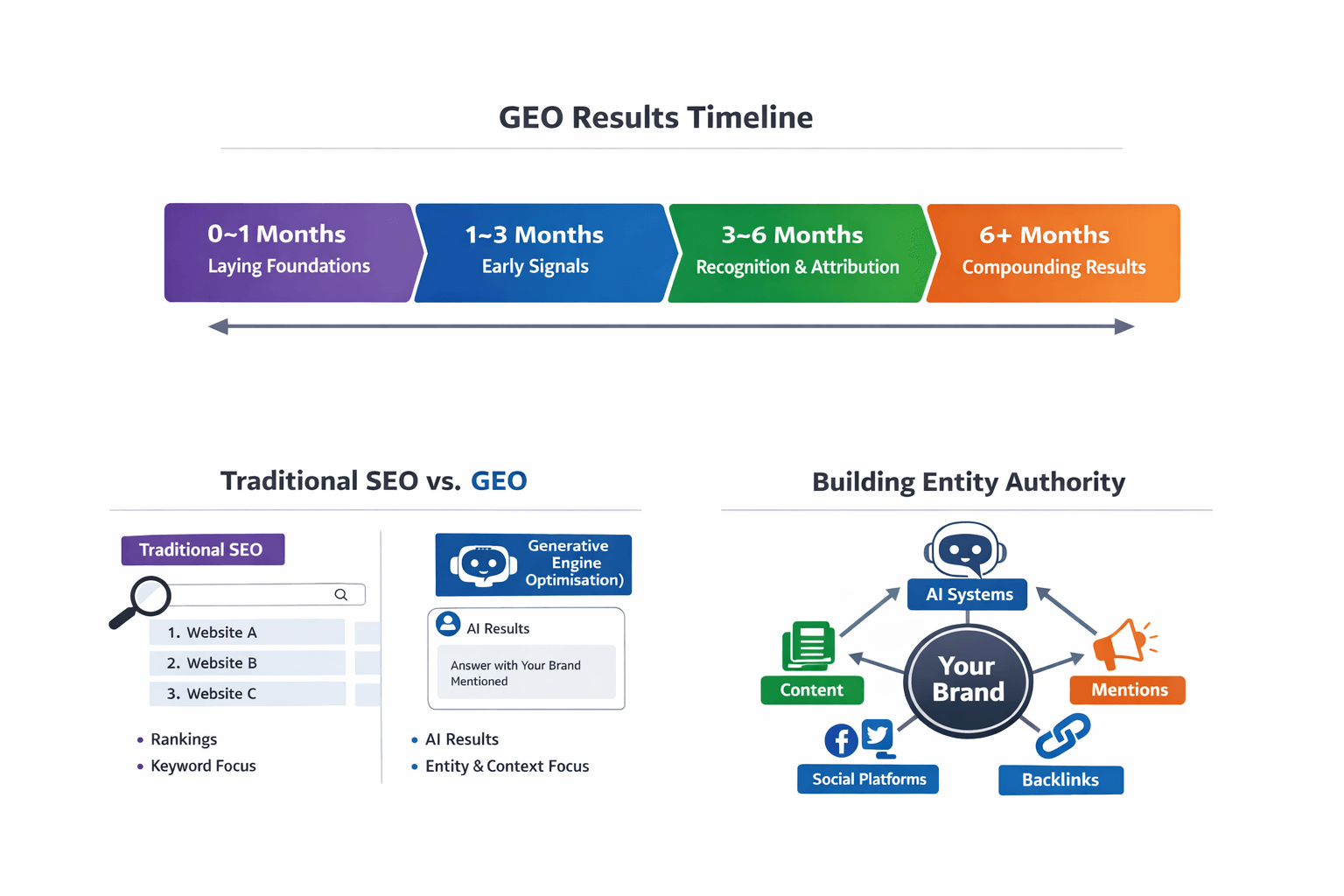
Search is changing fast. It’s no longer just ten blue links and a click through to your website. AI answer engines now summarise, extract, and respond directly to questions, often without the user ever visiting a page.
If you’re creating content today and ignoring how AI reads it, you may already be losing clicks or sales. In this guide, I’ll show you how to structure content for AI search and answer engines using simple, practical techniques. Let’s get started.
What Are AI Answer Engines and How Do They Read Content?
AI answer engines don’t read content like humans do. They scan, extract meaning, and look for clear patterns that help them understand what your page is about and whether it answers a question properly.
Instead of focusing on clever wording, these systems care about clarity, context, and structure. They want to see questions clearly answered, topics broken down logically, and supporting information placed exactly where it should be.
This is why many traditional SEO pages struggle. They’re written to rank, not to explain. AI engines reward content that explains things cleanly, confidently, and breaks topics down.
Why Content Structure is More Important Than Ever
When you structure content properly, you’re making life easier for both users and machines. AI search systems rely heavily on headings, paragraph order, and semantic relationships to decide what to show as an answer.
Poor structure creates confusion. Important points get buried, answers are vague, and AI can’t confidently extract a response. When that happens, your content is skipped.
In my experience, improving structure alone can increase how often content is surfaced in AI-generated answers, even without building links or rewriting everything.
1. Start With Clear Search Intent
Before writing a single word, you need to understand what the user is actually trying to achieve. AI answer engines are obsessed with intent.
If we use this article as an example, the intent is informational. The user (you) wants to learn how to structure content so it performs better in AI-driven search environments. That means your page should teach, not sell or promote.
Every section should tie back to that intent. If something doesn’t help answer the core question, it probably doesn’t belong on the page.
2. Use Strong, Descriptive Headings
Headings are one of the most important signals for AI understanding. Each H2 should clearly introduce a specific subtopic related to structuring content for AI search.
Avoid vague headings that sound clever but explain nothing. AI prefers direct language because it removes ambiguity.
For example, headings that explain “how,” “why,” or “what” work far better than confusing titles. They tell the system exactly what the following section contains and make extraction easier.
3. Keep Paragraphs Short and Focused
Large blocks of text are a problem. Not just for users, but for AI as well.
Each paragraph should communicate one clear idea. If you try to cram multiple points into a single paragraph, you reduce clarity and increase the chance of misinterpretation.
Short paragraphs also make it easier for AI engines to pull clean answers. If a paragraph clearly explains one concept in two or three sentences, it’s far more likely to be used as a quoted response.

4. Answer Questions Early and Clearly
One mistake I see all the time is burying the answer halfway down the page. AI answer engines don’t have the patience for that.
If a heading asks a question, the first sentence underneath should answer it directly. You can expand and add context afterwards, but clarity must come first!
This approach mirrors how featured snippets used to work, but it’s even more important now. Clear answers build trust with AI systems and improve your chances of being referenced.
5. Use Natural Semantic Language
You don’t need to stuff keywords. In fact, that often hurts performance with AI.
AI search relies on semantic understanding. It looks for related terms, concepts, and natural language patterns to understand depth and relevance.
By naturally discussing things related to your topic, you help AI connect the dots without forcing anything.
The goal is to sound like a human explaining something properly, not a robot trying to rank.
6. Create Logical Content Flow
Headings are great, but you also need an order to your content.
Start with foundational concepts, then move into practical advice, and finish with refinement. This mirrors how humans learn and how AI models understand progression.
Jumping back and forth between ideas confuses readers and weakens machine understanding. A logical flow reinforces topical authority and improves extraction accuracy.
7. Use Lists Sparingly but Purposefully
While long bullet lists can feel lazy, short lists can be useful when explaining steps or components. AI engines can easily parse lists, especially when they’re concise and relevant.
Use them only when they genuinely improve clarity. If a paragraph explains something better, stick with that.
My Opinion on AI-Focused Content
Content written purely for AI, without considering real humans, won’t last.
AI answer engines are trained on human behaviour. If users don’t engage with your content, trust it, or find it helpful, performance will drop over time. Structure for AI, yes. But always write for people first.
The sweet spot is content that explains things simply, is easy to scan, and feels like it was written by someone who actually knows what they’re talking about.
Final Thoughts on Structuring Content for AI Search
Learning how to structure content for AI search and answer engines is about clarity, intent, and good communication.
When your content is well-organised, easy to understand, and clearly answers questions, both users and AI reward you. That’s exactly where search is heading.
If you start applying these principles now, you won’t just survive AI-driven search. You’ll benefit from it.